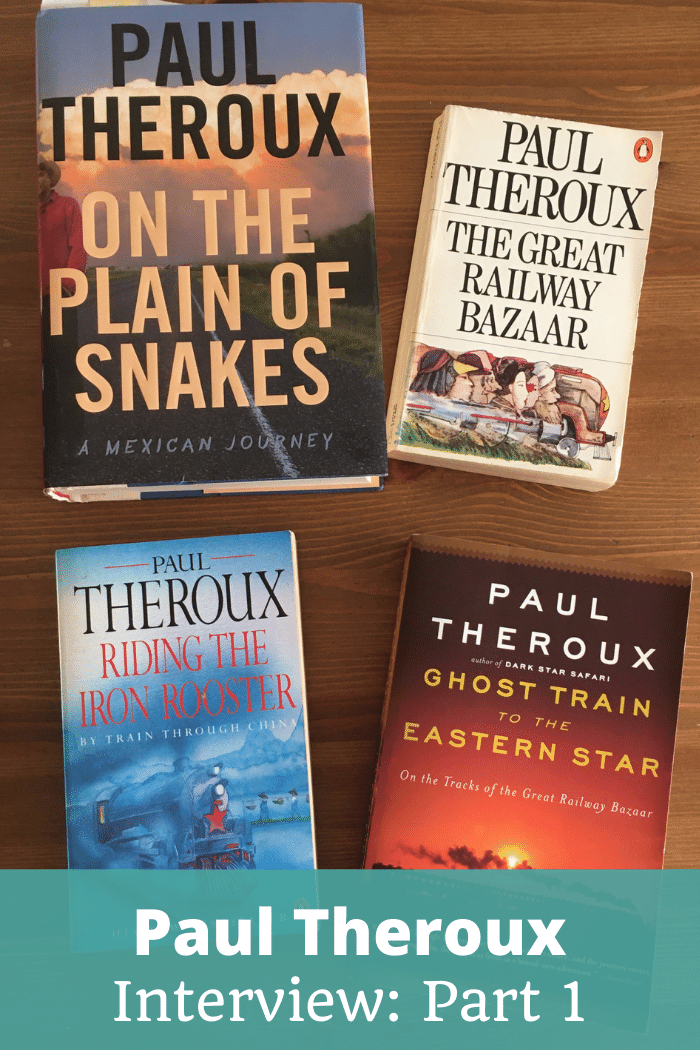
2020 has been a year of ups and downs, but as far as The Thoughtful Travel Podcast is concerned, mostly ups (who’d have thought?!). Here’s another one: I had the chance to interview travel writer Paul Theroux, one of the most well-known authors of all – I bet his books sit on many of your shelves!
I was nervous about this interview, but I needn’t have been – we had such a long and wide-ranging chat, and I’ve split it into two episodes as there’s just too much goodness to share all at once. Enjoy!
Show notes: Episode 214 of The Thoughtful Travel Podcast
Paul Theroux Interview – Part 1
I’d need a time machine to be able to tell for sure, but I think that Paul Theroux’s “The Great Railway Bazaar” was probably the very first travel narrative book I ever read. It shaped a lot about what I thought about travel – that you should talk to local people, that you should travel slowly, alone where possible, and not in a group of tourists, for sure – and it gave me quite an obsession with trains and the Trans-Siberian railway in particular.
So when I was offered the chance to interview Paul Theroux – of course, I said yes! Episode 214 is the first half of this interview – Paul was a very generous interviewee, and our chat is too long to publish in a regular episode, so you’ll find the rest in Episode 215.
In this half, our chat is wide-ranging and includes leaning languages, ways to get to know the locals, and the pleasure of teaching and studying in a foreign country – a very sneaky way to properly get to know a place!
Links:
- The Great Railway Bazaar
- The Tao of Travel
- On The Plain of Snakes
- The Kingdom by the Sea
- Join our Facebook group for Thoughtful Travellers – https://www.facebook.com/groups/thoughtfultravellers
Transcript
Amanda Kendle 0:00
Hello, and welcome to episode 214 of the Thoughtful Travel podcast. And it’s a very special episode. It’s an interview with travel writer, Paul Theroux. I was really excited to have the chance to interview Paul; as you’ll hear soon in my fan-girly first question, he really has had a huge influence on my life. I was thinking and tracing back my travel history. It’s all few decades back, so it’s a bit fuzzy but I know that Paul’s book, The Great Railway Bazaar somehow came into my possession in the ’90s. So I was in my final years at high school. I suspect I bought it secondhand at the annual Save The Children book sale. I used to go every year and come home with a huge box filled right to the brim of new-to-me books. And I think the Great Railway Bazaar probably really struck a chord for me right away. I was really interested in European history. I’d just been in Germany, in Berlin for German reunification. I was studying a lot of world history in year 11 and 12. Unfortunately, we didn’t look at Australian history much, that was very much Europe and Asia. And I was keen on train rides, I’d had some amazing train rides in Germany on that trip in the 1990s. My mum was obsessed with Russia and studying Russian language. So the Trans-Siberian part really appealed to me. And I really fixated on – one day – riding that train. A decade or so later, I finally did. So that was pretty cool. Over the following decades, I read many of Paul Theroux’s travel books, I always have dipped back into the Happy Isles of Oceania, his explanation of a kayak trip, including Australia, and any of his books where he took trains like riding the iron rooster, which is through China. And more recently, when he wrote Ghost Train to the Eastern Star where he retraces – where possible – he retraces the Great Railway Bazaar route he took. So anyway, I am sure my traveling and writing life would be totally different, if Paul Theroux had not published all these books. So how amazing to have the chance to chat with him. We spoke for well over an hour, and there’s just so much that interested me I couldn’t really bear to cut it down. So I’m going to release this episode in two parts. So this week’s episode includes us chatting about how to be a thoughtful traveler, the importance of speaking the language when you can, the impact of the internet and connectivity in the world today, and how that’s changed travel, and how internet research can be both good and bad. We talk about getting to know local people, which is a really important part of travel for me. And he certainly had some different ways which were really intriguing. And we also talked about something that’s really special for me, how being a teacher when you are traveling, or living abroad as a teacher is just a great way to get to know local people and culture. So enough of me, let’s on get on with my chat with Paul Theroux starting off with my embarrassingly fan-girly chat about how much his writing impacted my life.
I have to say, thank you, you influenced me and probably my whole life by writing the Great Railway Bazaar; I read it as a teenager. And I became obsessed with train travel. And you know, I ended up going on the Trans Siberian in my 20s purely from reading your book, and there’s not many people that I can say that about. So thank you, I think you really had a big impact on my life because I’ve traveled a lot, lived abroad in many places, and I think my life would be very different if I hadn’t caught that travel bug.
Paul Theroux 4:14
Oh, good. I’m glad to hear it. It’s nice to know that. Well, there’s two things I like about that. One is inspiring people to travel. The other is a teenager reading a book – the idea that young people are reading my work is something that is very pleasing to me because I like to think that I’m either reaching a new generation or that I’m not only talking to my own generation of very old people and who are sitting in easy chairs. I don’t think that I might be speaking to someone who’s going to get out there and do something, something sort of thing that I was doing myself.
Amanda Kendle 4:54
Well, I certainly I cannot count myself as being anywhere near as adventurous as you, but I hope that I emulate some of your attitudes to travel at least. So that is my first question: so on my podcast, we talk a lot about being a thoughtful traveler. And I wonder if I asked you, what do you think it means to be a thoughtful traveler? What do you think that might include?
Paul Theroux 5:17
First thing is you have to remind yourself of who you are, how small you are, and how unimportant you are. And that you’re in a place that you’re a stranger, that you really have no right to, you have no power, and that you need to negotiate everything that you have, you can’t take anything for granted. I would say the most thoughtful traveler is the one who realizes that he or she is very small. There’s a nice image by the poet Ferdowsi, who lived about 1500 years ago, give or take. And he said, ‘we are but dust in the lions paw’. That’s who we are as people. That’s actually the title of a book too, Dust in the Lion’s Paw by a great traveler. And I think if you remind yourself that that’s who you are, that you need to be watchful, you need to learn a language, you can’t expect people to speak your language, to agree with you. And that you need to be as humble as as possible. So I started my traveling in Africa as a teacher. So it wasn’t travel, it was sort of residence in Central Africa, in 1963, which now seems a long time ago. It was a long time ago, it was more than 50 years ago. So it was still a British colony, and, you know, segregated clubs, and it was called Nyasaland. I was a teacher, but the best thing I did was I learned the language. I learned to speak the language culture Chewa, so I could speak it, I could still speak it because I learned so early, it’s still in a cast set in my head. And that’s something, a lot of the British people there did not speak the language. And so because I spoke the language – it was quite a lot of trouble to learn – but I was in a program that taught the language before I left, I was a Peace Corps volunteer. Because I spoke the language – it wasn’t just that I was an American, or that I was young, or that I was a white person – it was the fact that I could actually speak to people in their own language. And they said things to me that they had never said to anybody else. And I remember how angry they were, there were workers around the school – cooks, gardeners and whatnot – and they would say to me, they had meetings and they were very agitated about British occupation. And they told me how humiliated they were and why the British people in charge here. I remember, one in particular, who was a real firebrand, he was like a character in a Melville story, Benito Cereno, he was very quiet when he was a cook. He was the cook of a Scottish teacher. And he used to bring the marmalade and I’d see him, and he’d say ‘yes Bwana, No Bwana’. But later, he was he was really, really angry. And, you know, revolutionary. And he used to agitate the other African workers and so forth. But he was ranting to me, but in a really friendly way. He was saying, ‘Why don’t these people understand?’ and this sort of thing, in his own language.
Amanda Kendle 8:43
You had the privilege of that because you had taken that effort to learn the language. So you then had that privilege, to be able to get that extra side of it, that the perhaps other expats didn’t get.
Paul Theroux 8:54
Yes, and it takes a lot of work. And I think, quite a lot of belief to learn a language. It’s not difficult. It doesn’t take brains to learn language, but takes application. Learning a language is… children learn a language, even not very bright children, learn languages, not very bright people learn languages; it’s an activity, it’s like learning to bounce a ball, you know, play a game. SoI would say that’s the first thing – be humble. Realize that you’re small, that you’re dust in the lion’s paw, that you’re disposable, that you’re at risk, you’re alone, you can be taken advantage of, and that you need to meet people on their own terms. You can’t come and say ‘I’m an American. Look what we’ve given you.’ That’s not only Americans, but others.
Amanda Kendle 9:48
Absolutely, not just Americans but a lot of privileged Western travelers I’ve seen act that way. For sure.
Paul Theroux 9:54
They say they want a personal reward for government funding. You know, ‘we’ve given you this dam, we’ve given you this railway’, or whatever it is. But it’s a different world now; it’s a connected world. So I would say one of the things that you’re dealing with, well, you’re in Perth, Australia, I’m in Sandwich, Massachusetts, we’re speaking and looking at each other. When I first started to travel, I used to write postcards and letters. In fact, I didn’t really get connected to the internet in the early ’90s. And the internet was, I guess, later than that, but I still write in longhand, you know, I mean, here is my high tech. I write with a pen. But now we’re in a connected world; a connected world can give you ideas beyond yourself and make you think that because you’re connected, you’re safe, and you can talk to anyone, go anywhere, find out anything. I think the understanding that travel is a laborious business, and that you need to do it slowly, and with understanding – you can’t just look at a Google map or Wikipedia or find out information that way. You need to find out firsthand what things are. And you find out that by watching, by listening, not by being big and bossy. So those are simple but – I think – important lessons. I also think this is applied to the connection thing, which is it’s very important to leave home, I mean, to completely leave home, and not depend on your connection to home, of calling home, emailing and so forth. I know people do it, and even I do it – I call my wife, I email and so forth – but it’s better, the more disconnected you are from home – in life, as well as travel – the better off you are. I mean, when you’re making your own decisions, and you’re not referring to people at home or looking for a support system.
Amanda Kendle 12:00
You are truly making your independent decisions. It’s really interesting, that you discuss this. So when I first traveled without my parents, I was 14 and I was traveling on a school trip, but we spent a month in Germany. It was 1990, and there was no Internet, of course, and yes, we had a teacher there with us. But we would be sent off to our different host families and we had no contact at all with our parents for the full month we were away. And now that I have a 10 year old, I think, How did my parents survive this, but it was the making of me to be, you know, relatively independent at that age and to be in a foreign country trying to speak the language. And then later on in the early 2000s, I lived in Japan. I didn’t have any access to email, except once a week at an internet cafe. And I would travel and backpack and just turn up somewhere maybe with my guide book and just find a place by walking down the street. And nowadays, that just doesn’t seem to happen. Or you have to really force yourself to do that. Because the internet and smartphones makes all of this so simple. Why wouldn’t you have looked things up before you got there? But I really miss what you’re describing, you know, you’ve traveled in that way a lot more than me, but I really miss that. Just wing things, don’t have that connection, just figure out as you go along. Ask people when you’re somewhere already, don’t know everything in advance. But how can we do that now?It’s hard to do that now that we have all of this connectivity.
Paul Theroux 13:31
I think that connectivity is misleading. I think that a lot of what’s on the internet is inaccurate. I know that to be a fact because there were quotations by me on the internet of things I didn’t say, or I didn’t say it in exactly that way. And I know that when I’m doing research… I wrote a book called The Tao of Travel, which I recommend to you. People used to say ‘what’s your favorite travel book?’ And I say, Well, I really don’t have a favorite travel book. I have 300 books that I could – more – that I could mention to you, and 50 really core favorites. So I compiled an anthology of travel, quotations and books to read, quotations from my work, from other people’s work, and then topics like food and travel and how long does a traveller stay? There’s one chapter about how long a traveler was in a particular place. For example, D.H .Lawrence wrote a book called Sea and Sardinia. It’s a 200 page book. How long was he in Sardinia? Well, he was there for 10 days.
Amanda Kendle 14:42
That’s not enough, surely.
Paul Theroux 14:44
The book is not bad, but it’s very impressionistic, but 10 days, including getting there – he went there from Sicily to Sardinia and back – so he spent about a week actually in Sardinia. How long was Kipling in Mandalay? You know, On the Road to Mandalay? Well he never went to Mandalay. How long was Mark Twain in around the world and how long was Graham Greene in Mexico? Turned out six weeks. So in researching this Tao of Travel, I was constantly checking facts, and a lot of times the books that I read – the D H. Lawrence book, The Graham Greene Book, the Mark Twain book, even Battuta, Ibn Battuta traveled for 26 years, he traveled from Morocco to China to India, Tabak. He didn’t get to Australia, but he got to most other places, he traveled through the Muslim world – I kept running up because I was actually borrowing books from the library and reading it, and then I would check with the internet; the internet often had inaccurate numbers, figures, places, quotations, and so I depended solely on the books that I was reading. So you say how can you prepare? The best thing is firsthand experience. I wrote a book called Deep South. It’s about a road trip I took around the United States. And Deep South is about the rural parts of the south Mississippi, Alabama, South Carolina and Arkansas and elsewhere, the country roads of the Deep South. And people consistently say to me ‘did you go to Charleston, Hilton Head, that’s really nice?’ But South Carolina is really wealthy, and I’d say it’s not wealthy at all in the places I went. I was in the poorest county in the United States, practically the third poorest Allendale, South Carolina and Allendale county, or in places where people were living in shacks, you know, and people were talking to to me about ‘Well, at the moment, there’s a big golf tournament on, The Augusta National.’ If you go to Augusta, you’d say God, this is a lovely place. If you walk outside Augusta, just Augusta Georgia, which is happening right this minute. If you saw it on television, you’d say ‘God, what a lot of great golf, it’s so green, it’s so lovely.’ A mile or two outside of Augusta is the Savannah River, there’s an atomic energy plant that’s polluting the river. There’s a very, very poor community right next to it. And so you would have a very distorted notion. So if you look at the internet, Augusta, you’d say God, that’s a very salubrious place. But if you go there, get in your car and drive a little bit outside, you’ll find very poor black communities that have nothing. They have nothing, they have leaky roofs. They’ve been overlooked. And that’s what you write about. Instead of writing about what’s on the internet. And you know, the popular event the golf tournament, you look at everything else, the circumstances of a place. So it’s not the destination….
Amanda Kendle 17:36
It’s everything but.
Paul Theroux 17:39
It’s the getting to the destination. So if you’re going to go, you’re going through all this. So it’s the journey, not the arrival that matters. And that’s really, really important. And I think that’s what you don’t get when you’re doing research and so forth and look at the Internet. It’s the going there. In the south I was driving, but I stopped my car. I talked to people and I went to cattle shows, gun shows. I mean, the average gun show, and I don’t know whether you have them in Australia…
Amanda Kendle 18:12
We don’t have many guns here. So I guess there are gun shows. But I’ve never been to one.
Paul Theroux 18:18
Well it’s an American tradition to tow a gun for a lot of people. But a gun show is just… every one, you go into a hole. I had never had this experience. Although it turns out we do have them in New England, they’re not like the South, which is tables piled with guns and swords and military insignia and whatnot, and people dressed up in uniform. And you can actually go to a gun show in the south and say, ‘What’s that say?’ ‘Oh, this is a this is a luger. This is a nine millimeter German Luger. My uncle got it in Germany after the war.’ ‘Is it for sale?’ ‘Yeah’. And then they’ll say, ‘Well, if you’ve got the money’, and you say ‘is it a private sale?’ ‘Yeah’. And so you give them the money and you walk away, gee whiz. But that was the gun culture in the South. There’s also big Confederate Civil War culture. It’s stuff that you read about, but when you’re right there talking to people, and if you’re writing a book, and I mean, you need the human voice.
So I think you need to prepare yourself, you know, you’ve got to know where you’re going and and why you’re there. I’ll give you another example where the internet is somewhat useful, but can be misleading. So I wrote a book on Mexico. It came out last year On the Plain of Snakes. Another road trip. I drove from here where I am now – I’m in Sandwich, Massachusetts. I got my car and I drove to Texas, I drove to McAllen, Texas, I drove up and down the border, and I drove into Mexico, but I knew that I was going to the southern most province or state of Mexico, Chiapas. And to get there, I’d have to go through Juchitan, which is a town on the Isthmus. And I knew that they had an earthquake there, so I looked at Juchitan and the earthquake. And we talked about the earthquake, how many people died, and it was terrible. It had happened six months before I went there. And it mentioned, it said, Juchitan is famous for its muxes. The word is m-u-x-e-s. Well, muxes are transexuals. They’re men. Well, they’re women. They’re kind of intermediate sex. They’re not men, but they are. And they’re not women, either. But they’re this transgender, I suppose. So maybe you’d say they’re women, or they would pass as women. But it’s a whole culture – so it’s not just a couple. There’s thousands. And it’s famous, but I didn’t know that muuntil I looked at it on the internet. So I made a note of this, find out about the muxes. So I went there and then met a couple of people. And I said, Can you tell me about this? They said, Yeah, I’ll introduce you a guy who knows this. And because I had the clue on the internet, about the muxes, because I had that, it’s unique in Mexico, the culture, they occupy a place in a social structure, they’re a protected group. And they have a festival every year that’s called the Vela (de las Intrepidas). So I found out about that, you get clues from the internet, I suppose. And then you go to a place and expand that knowledge. But you can’t depend on a book or the internet. If you’re a traveler, the whole purpose of travel, is to find out firsthand what’s going on. And I think if you have that in mind, then you’re not depending on the internet.
Amanda Kendle 21:49
Yeah, I think that’s right. I like the idea that there are clues on the internet. And that’s the kind of thing that I like to explore. And then you’ve got questions in mind that you can find the right people to chat to, or you’re just looking out for those kinds of things. I want to go back to something you said. So I know you mentioned when you were in Malawi, you worked as a teacher, and I know I’ve read The Plain of Snakes, and you had a stint of teaching in Mexico as well. And I was teaching English in Japan and Slovakia and Germany over the years. And I’ve long thought that it is one of the very best ways to get to know our country, it’s sort of cheating in a way, you’re almost not traveling. I mean, I was getting paid, so that helps as well. But you have this special opportunity to tap into local people, and ask them nearly anything, because you’re a teacher. I mean, I was teaching a language, So there was an excuse to talk about all sorts of things, and people would want to tell me things. And I’ve often felt it’s one of the best ways to travel or to get to know a country. I’d love to know what you think about that.
Paul Theroux 22:55
I completely agree with you. I couldn’t agree more. I think that the most rewarding travel experience I had was as a teacher in Africa, and I was a teacher in Africa for six years, two in Malawi, four in Uganda. And I was a teacher in Singapore for three years. So there’s nine years of teaching, and then I’ve taught in other places. So I could probably say I spent 10 years of my life teaching and being resident in a place. The other thing – so you’re a teacher and you have students, so you’re finding out what they -care about. But the other thing, I discovered this, I don’t know whether you notice it in my Mexico book – that when you’re a language student, you’re constantly answering questions. So I had forgotten this, that language learning is all about interrogation. So someone says to you, what’s your favorite sport? You say? My favorite sport? Well, football, why do you like it? I like it because on Sundays you watch television, or I go to a game. And what do you like doing? Well, I go out with my friends. Or what’s your favorite book? Well, my favorite…, or your favourite author… and you’re talking about yourself or your family. And unless you’re a liar, you’re revealing everything about yourself: what you like, what you don’t like, your favorite food, where you like to go, where you’ve been, how you grew up, what your parents (do) and this interrogation in language learning is very helpful for the teacher because the teacher is then finding out what what do you like to do? Well, where do you go? What’s your favorite proverb? What’s your village like? Do you have a ritual that you’re afraid of? Of circumcision or child marriage or you know, marry your cousin or whatever. So, in Africa, if a woman’s husband dies, she has to marry his brother, when in Malawi. This is the case and in some other place, so she has to, she’s compelled to marry his brother. And in some cultures, this is the case, the uncle is a very important figure. And so the woman – the widow -marries her brother-in-law So occasionly people used to say to me, I don’t want to do that. And I think this is interesting. And so it’s a language class, but it’s also an education for you as a teacher. And you’re in touch with a group of people who are very impressionable, too, and they want to know about you. So I agree with you – you were in Slovakia, you were in Germany, you’re in Japan – you know much more about those places as a teacher, than you would have if you were on a tour bus, just getting off and looking at the local church or the local museum; you’re inside, you’re actually talking to people. The other thing that happens is you’re invited to their houses, something that rarely happens in travel: you meet people, you go to a restaurant, they talk and then they go (home), you go back to your hotel, and they go back. But when you’re a teacher, when you’re there, they say, ‘Well, we have a birthday, can you come?’ and then you go and you bring a present or flowers, and you sit with this group of people and you’re you’re talking. Being invited into someone’s house, in a country is a great honor and a privilege. But it’s also the most revealing things that can happen. There are some cultures that don’t entertain at home, the French don’t entertain at home. I think when you were in Germany, you will probably very rarely in someone’s home if you were a tourist. Maybe as a teacher, you were.
Amanda Kendle 26:17
But even then it’s not so common.
Paul Theroux 26:22
In Britain, this is the case. I mean, I lived in England for 17 years. And I rarely rarely – except for a party – I was rarely invited into someone’s house. I lived in a street, we had neighbors in South London.. 17 years! I think there was only one house where I was invited in and and even then it was… it wasn’t grudging, but it was a very chilly experience. It wasn’t a big warm ‘come in’, like happens in other places, Africa, India, I don’t know, Southeast Asia, Mexico, where you’re invited in. So France is notorious for that – I don’t know, maybe people live in a very tiny house, very tiny, flat, whatever it is, and you can’t go in, but the idea is when you’re a teacher, the likelihood of you’re being invited in the house. That’s where a culture thrives, in the house, not in the restaurant. I mean, you go to the restaurant, you eat through national food, you say, Oh, this is great. This is wonderful. I love this… but go into someone’s house.
One of the aims of travel, I suppose, is to find this intimacy, or the domesticity in someone’s house or hut. So in Africa, you might have a mud hut, you don’t go, but someone could live in a very grand apartment in England or Italy or France, and you won’t get there. So, that’s one of the paradoxes, I suppose. But also, travel isn’t just about exteriors. It’s about penetrating, getting getting inside the culture. You get inside through the language, you get inside by negotiating, by making a friend. The great privilege is to get into someone’s house. As I said, it doesn’t happen much. And I should say, in 1982, I had lived in Britain for 11 years. And I thought, I know nothing about this place. I’ve lived in South London for 11 years. And so I thought I wanted to find out about living in Britain. So I wrote The Kingdom By the Sea. I decided to walk around the coast, walk, take trains, take buses, but walk as much as possible around the English coast, and then the Scottish coast and the Irish, Northern Ireland, and then down the other side. But at that time, this is ’82 during the Falkland war, I stayed at Bed and Breakfasts. Now Bed and Breakfast, I discovered, it’s just someone’s house. At five pounds. You go up, it says Bed and Breakfast – vacancy. I would get to a little village or town, and look for the vacancy. B&B. It’s a bit like an Air B&B…
Amanda Kendle 29:16
precursor. Yeah,
Paul Theroux 29:17
IAnd I’d say ‘do you have a room’. Yes, yes. Yes. Yes. How much? Five pounds – because that’s what it cost then. Now it’s much more, and I give them my five pounds. And they’d show you, you’d go through the person’s house – just right this way – and you go through the living room, the parlour, the kitchen, then up the stairs to this little tiny bedroom. And various times they’ll say ‘we’ll share the bathroom’. Okay. But you might say, well, that’s horrible, but actually the smaller and more intimate, the more you find out? Then you say ‘well, do you have a TV?’ They say? Yeah. Well the Faulklands War was on, so we’re going to watch the news. So I’ll get down into the hall or living room where the TV was, we’d sit, have cups of tea and watch the news about the Faulklands war. And then there’ll be a table with an album on it, amd I’d say’Oh, that’s interesting’. ‘Oh that’s our wedding album. Do you want to see it?’ And then I’d look. So after the Faulklands, we’ll look at their wedding album. ‘Well, Reggie and I were in Majorca and this is Reg. And that’s Reg with a funny hat’. And I’d say ‘well this is great’. So when I wrote the book, this was a way to find out how English people live, was to go to a bed and breakfasts, pay five pounds, and for the five pound admission, was admission to the the life, the house, the wedding album, the kids and that was my method.
Amanda Kendle 30:20
That’s a great method.
Paul Theroux 30:46
Yeah, it worked. Now, if you looked on the internet, so how much is a bed and breakfast in Ilfracombe or I don’t know, Broadstairs, Margate. It’s probably… I don’t know what it would be, 50 pounds maybe? Well, more anyway. Maybe fifty? I don’t know.
Amanda Kendle 31:04
But it’s so worth it.
Paul Theroux 31:06
Yeah, except they’re probably wise to that now. They probably put you in the garage or something. But anyway, so that was this admission to the intimacy. So each time I’ve written a travel book – I’ve written 12 travel books – I’ve tried to figure out how am I going to do this? How are we going to travel? How are we going to meet people? What language do I have to learn? How long do I have to, you know, to be away from home? Is this one trip, maybe a month here, two months, over the course of a year or a yearand a half? And I need to figure it out? In other words, it’s not like spending…. It’s not like, well, Bruce Chapman wrote a book about Patagonia. So he went to Patagonia. He walked, he took buses, and then he came home. So he was there about three months in Patagonia. That’s one way of doing it. And I’ve done that to the Great Railway Bazaar, which you mentioned, I was away for four and a half months, so I left, got homesick, kept traveling, got more homesick, kept traveling. And then, but then finally I was… It’s too long. When I came back, my life was in ruins. I mean, my wife was angry, my kids barely recognize me. So that was bad. So I thought I gotta figure out how to do it so I’m not alienated from home. But all of these are decisions that the traveler makes, that the tourist or the holiday-maker doesn’t have to make. If you’re going for a week to Japan or to Bali for a couple of weeks – I mean, that’s fun and it’s pleasant – so there’s no there’s no real challenge. There’s a lot of people who will welcome you, but traditionally, the traveler isn’t welcomed, you show up and hope for the best.
Amanda Kendle 32:49
Well, that’s this week’s episode of the Thoughtful Travel podcast. Next week in Episode 215, I will play you the rest of my chat with Paul Theroux. As always, thank you so much for listening. Bye for now.
You might also like:
 Paul Theroux Interview Part 2 – Episode 215 of The Thoughtful Travel Podcast
 How Authors Travel to Research Their Novels – Episode 43 of The Thoughtful Travel Podcast
 Reading Books to Inspire Travel – Episode 153 of The Thoughtful Travel Podcast
 Travel Writing World Collaboration: Episode 257 of The Thoughtful Travel Podcast
Leave a Reply